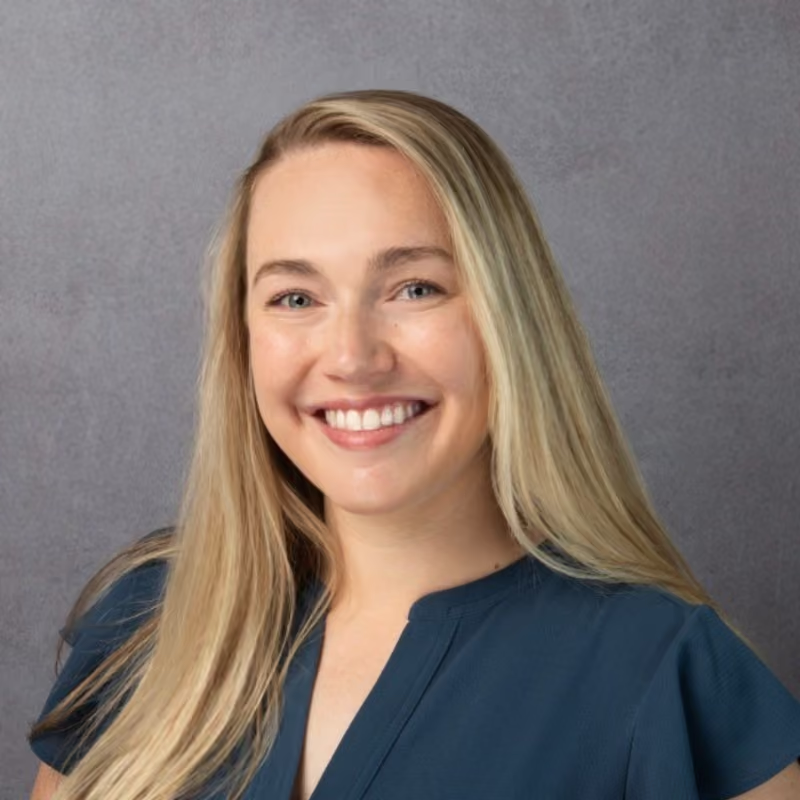
Sean Riley: Welcome back to unPACKed with PMMI, I'm your host Sean Riley. In this episode, we chat with Charlotte Ashcraft of Just Born Inc. about how PACK EXPO East helps CPGs and brands solve real packaging challenges, from handling delicate products to navigating sustainability and EPR requirements, and why hands-on access to suppliers and technology matters.
So with all the fancy introductions out of the way, welcome to the podcast, Charlotte.
Charlotte Ashcraft: Thanks for having me.
Sean Riley: The pleasure is all ours. So I'm familiar with Just Born, but for our listeners, could you just give us a little bit of a background about Just Born, what you guys make, and what kind of packaging or processing challenges you're focused on right now?
Charlotte Ashcraft: Yeah, sure. So Just Born is a family-owned confectionery company. We've been around for over 100 years, and we're headquartered right here in Bethlehem, Pennsylvania. We manufacture iconic brands like PEEPS, Mike & Ike's, Hot Tamales, and Goldenberg Peanut Chews. And we still make PEEPS, Mike & Ike's, and Hot Tamales in the same facility that we've been in since the 1930s in Bethlehem.
Sean Riley: Wow.
Charlotte Ashcraft: So that's really interesting. And we can get into that a little bit more because that presents some unique challenges. But Peanut Chews are also still manufactured in Philadelphia. So that's a very beloved brand in the city of Philly.
But what really defines Just Born's legacy, though, is the role the company plays in our local community. So being family-owned, we're not just about growth, we're about increasing our positive impact. So when we grow the business, we create more jobs, strengthen local partnerships, and expand the ways that we give back. So that connection between growth, community, and long-term stewardship is a huge part of who we are and how we make decisions.
Sean Riley: Love that. Our offices are in Herndon and Chicago, but I'm based in Philadelphia, so I'm very familiar, definitely with the Peanut Chews, but with the Peeps. I've been to Bethlehem a bunch of times. And that's wonderful, the whole community-oriented aspect of it. I love to hear that.
Speaking from a PACK EXPO point of view, you guys have attended PACK EXPO events in Philly, Vegas, and Chicago. What keeps you coming back? How does the show help you address your challenges? How's it helping you address your current challenges? How has it been a theme that you guys have stuck to every year?
Charlotte Ashcraft: Yeah. So we go and keep coming back to PACK EXPO because it is so practical for our teams. We're able to see equipment, materials, and automation solutions up close and have those conversations about what will actually work in our environment. Given our space limitations, being in an over-100-year-old facility and the delicacy of some of our products, especially Peeps, PACK EXPO helps us identify technologies that can handle those constraints without compromising quality.
So it's one of the best places for us to pressure test ideas because we can collaborate with multiple vendors, our own cross-functional team, and then also talk with integrators, too. And maybe introduce them to some other solutions that we're interested in exploring, but want to use them as an integrator.
Sean Riley: Okay. Very interesting. And I know you guys visited PACK EXPO East. You were there personally, and you brought your whole procurement team, which is a thing that we use to promote PACK EXPO East, which is that you can bring your whole teams or some maybe junior staff that you might not be flying to Vegas or flying to Chicago with that regional event feel. So what stood out to you, and why was it important to you to be able to bring the whole team down?
Charlotte Ashcraft: Yeah. PACK EXPO feels very approachable and focused for us. So it makes it easy to have these meaningful conversations. And bringing our procurement team was important because equipment and supplier decisions are cross-functional by nature. They're involved end-to-end in all of those decisions and solutions, too.
So having them see those technologies, ask questions directly, and really be able to see the integration between the equipment and the material was important and valuable for them. They're able to hear and see the same information, and it made our follow-up discussions a lot more productive. And it really just helped us align expectations cross-functionally across our team.
Sean Riley: Okay. Very interesting. And I'm jumping a bit, but how do you approach automating things and robotics for handling things like Peeps? They're very delicate. We can't do everything manually anymore. It's just not as fast. So how do you guys handle delicate things like Peeps without compromising the quality you've established for 100 years?
Charlotte Ashcraft: Yeah, it's a huge challenge for us, but it's really forced us to come up with some creative solutions, and that's probably one of the more fun parts of my job.
Sean Riley: Oh, cool.
Charlotte Ashcraft: But with products like Peeps, automation has to be designed around the product. The packaging has to be designed around the product, not the other way around. So they're really delicate, especially when they're warm. We actually can't even ship them over to our warehouse until they've hit a 24-hour mark after they've been produced, because the temperature inside the Peep still hasn't come down to room temperature.
Sean Riley: Wow.
Charlotte Ashcraft: So handling is really critical. We spend a lot of time defining packaging and handling requirements upfront, and then we work closely with those equipment suppliers to make sure automation solutions are precise, gentle, and reliable. So in some cases, that also means redesigning the packaging structures completely so that they better support automation while maintaining quality and brand integrity. But if that's the best solution for us, we're going to go take a step back and do all of that work and really put out the best product and packaging the first time around.
Sean Riley: Very interesting. Okay. Another thing that I keep thinking of, especially when you say it's a 100-year-old facility, is sustainability-type things that people weren't thinking of 100 years ago. We're bringing EPR and extended producer responsibility into play. Sustainability is such a big deal. It's reshaping how people do their packaging. How do you guys tackle that, and has PACK EXPO helped in any way to stay ahead of that sustainability curve?
Charlotte Ashcraft: Yeah, absolutely. And all the sustainability and regulatory requirements have become a huge part of my own job. But especially EPR, it's really forced us to take such a granular look at our entire packaging portfolio. We were putting out metrics, and they were based on some assumptions. And last year, we just took the time to completely redo everything and take an entire granular look at our whole portfolio. And what we realized was that over 90% of our consumer-level packaging is already paper-based and recyclable. So we're starting from a much—
Sean Riley: Good.
Charlotte Ashcraft: —better starting point than we initially thought.
Sean Riley: Yeah, that's a very good place to start.
Charlotte Ashcraft: So it was time well spent for sure. But one of the remaining challenges is really flexible packaging. And we're actively working to validate recycle-ready structures. PACK EXPO has been a really valuable resource in this area, helping us connect with suppliers and solutions that can support compliance and practicality.
We have a very long shelf life on Peeps, so the testing for that is very long. So we have some of these requirements coming up in 2032. And that seems so far in advance that we have to be in recyclable packaging, but for us, we need to be doing that validation work now.
Sean Riley: Interesting. With the shelf life, you have to take that into consideration, regardless of how far out it's going. Okay. Can you share maybe a specific PACK EXPO win, that we'll call it, where you guys discovered something on the show floor, and you brought it back to Just Born, and it turned into something that you guys were able to apply as a real solution that you found there?
Charlotte Ashcraft: Yeah. So this is one of my favorite stories.
Sean Riley: Love it.
Charlotte Ashcraft: One of my favorite PACK EXPO success stories actually started with one of our former interns. She was participating in a student activity through her college at PACK EXPO, and she came across a soft robotic gripper that immediately stood out as a potential solution for handling warm, delicate Peeps in a pick-and-place application. So she texted our former boss at the time, who texted the engineer who was at PACK EXPO to go take a look at it.
And long story short, we ended up implementing that solution along with other automation. So we used an integrator to integrate that soft robotic gripper along with some of their other technology. And a few years later, we applied it to a second packaging line as well. So we have two full packaging lines that have this technology still, and that's working out really well for us.
But it's such a great example of how PACK EXPO brings together innovation and problem-solving and even workforce development, and just encourages people to think outside the box and come up with creative solutions.
Sean Riley: Yeah. As you were saying it, I was like, this is checking every box that PACK EXPO is trying to offer. An intern discovered that and set that in motion, and it's something you guys are still using. That's amazing.
Charlotte Ashcraft: Yeah, it is.
Sean Riley: Yeah. Okay. We're coming up on 10 years of PACK EXPO East in the spring. And we've added the Container and Materials Pavilion, the Incubator Hub. These are two new features that we're adding to the show. What are you personally most excited to see, and what should other CPGs come to PACK EXPO East looking for? What should they be excited about with PACK EXPO East 2026?
Charlotte Ashcraft: Yeah, I'm really excited personally about the Containers and the Materials Pavilion. A large percentage of CPGs come to PACK EXPO specifically looking for packaging materials. And having that concentrated just in one area helps teams think a little bit more holistically about packaging decisions, I think.
The Incubator Hub is also exciting because it shines a spotlight on emerging technologies and local innovation. And I'd encourage other CPGs to come check out PACK EXPO East, specifically looking for practical solutions or even just meaningful conversations. And think of it as a thought container for a cross-functional team so they can come up with ideas that they can realistically bring back and implement.
Sean Riley: Yeah. And you've given us great examples of where you were able to bring back and implement. So that's great. And this was great. I thank you, Charlotte, for taking some time out of your day to come on here and give our audience an overview of Just Born and how Just Born has attacked PACK EXPO. So thanks again, Charlotte.
Charlotte Ashcraft: Yeah, absolutely. My pleasure. Thank you