Trump threatens additional 10% tariffs on 8 European countries: On 18 January, President Trump announced on Truth Social that imports from six EU Member States (Denmark, Sweden, France, Germany, Netherlands, and Finland) as well as Norway and the UK will be subject to an additional 10% tariff on 1 February in response to the countries’ opposition to U.S. control of Greenland. If a deal for the United States to purchase Greenland is not reached by 1 June, the tariff will increase to 25%.
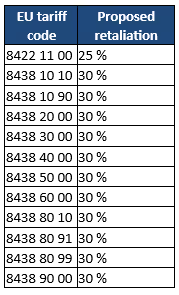
In retaliation, the EU is considering enacting tariffs on €93 B worth of American goods. This tariff package was previously suspended as part of the US-EU trade deal last August, but is set to expire on 6 February. The EU’s retaliation measures include tariffs on food processing and packaging machinery up to 30%. (See below list of EU tariff codes on the list, and the TARIC for descriptions of goods.)
Based on the last 12 months of the latest data available (October 2024 to September 2025), US exports to the EU countries totaled $531.5 M. There are no official publications from either the United States or the EU on implementing either of these measures.
In addition to possible retaliatory tariffs, reporting indicates that the EU Parliament is considering putting on hold the EU’s implementation of the US-EU framework agreement. The EU’s proposal, which had been due to vote on next week, would potentially remove tariffs of 1.7% on food processing and packaging machinery exported from the United States to the EU.
US steel industry testifies in support of stronger trade protections: On 14 January, the annual “State of Steel” hearing was held where industry executives testified before the Congressional Steel Caucus in support of the Section 232 tariffs as well as advocated for stronger trade remedy enforcement as well as stricter trade rules with Mexico and Canada. Several executives also recommended updating the USMCA agreement to require that all steel intensive products be made from steel melted and poured in North America to receive preferential treatment. If this recommendation is implemented, manufacturers located in Canada and Mexico that are exporting into the United States, and US manufacturers exporting to Canada or Mexico under USMCA may face new rules of origin and restrictions.
US-Taiwan Trade Deal Announced: On 15 January, the United States and Taiwan announced a trade deal that lowers the IEEPA reciprocal tariff rate from 20% to “no more than 15%”. The announcement did not provide an implementation date. Given the language, we anticipate the tariff applied may mirror that under the Japan and the EU agreements, where the tariff is 15% or the MFN rate, whichever is higher. Taiwan is the 7th top source market for food processing and packaging machinery with $113.6 M imports based on the last 12 months of data available (October 2024 to September 2025). In return, Taiwan committed to increase investment in U.S. semiconductor, energy, and artificial intelligence sector. The announcement does not address whether Taiwan’s tariffs will be removed for U.S. industrial goods. U.S.-manufactured food processing and packaging machinery into Taiwan currently face tariffs of up to 4%.
Status of US bilaterial negotiations and discussions: Please see the chart below for the latest on how certain countries are engaging with the United States in effort to reduce reciprocal tariffs and conclude bilateral deals.
Market
Status Update
Summary
EU
Agreement Framework released through Executive Order.
EU reduced tariffs on US goods not yet implemented.
18 January 2026: Agreement not yet implemented by the EU. President Trump’s threat to impose tariffs on European countries unless the U.S. is allowed to purchase Greenland may impact implementation. Please see more information above.
1 November 2025: US and China announce trade deal. Federal Register notices include information on US modifying China’s IEEPA tariff to 20% (10% IEEPA fentanyl + 10% IEEPA reciprocal). Higher reciprocal tariff increases paused until next year.
28 October 2025: Fact Sheet includes additional information regarding Japan’s investment commitments in the United States including energy, AI infrastructure, and electronics and supply chain.
1 December 2025: South Korea introduced legislation in parliament to implement the US–South Korea trade agreement.
Retroactive to 1 November 2025: IEEPA duties on South Korea will be 15%.
Fact sheet includes additional information on South Korea’s investment commitments in the US, South Korea’s IEEPA reciprocal tariff rate, and reductions on Section 232 tariffs for auto and auto parts, timber and lumber, pharma, and chips.
14 January 2026: Switzerland’s Federal Council adopted the final negotiating mandate for talks on the trade agreement with the United States.
Retroactive to 14 November 2025: IEEPA duties on Switzerland will be no higher than 15% (imports subject to 15% or MFN rate, whichever is higher).
The Federal Register Notice notes that refunds of duties collected will be processed pursuant to applicable law and CBP procedures. Importers sourcing from Switzerland may file post-summary corrections to recover duties originally assessed at 39%.
12 January 2026: Preparations ongoing for the USMCA mandatory 6-year review in July 2026. Canada and US to meet in January to discuss USMCA.
Mexico
Negotiations ongoing
12 January 2026: Preparations ongoing for the USMCA mandatory 6-year review in July 2026.
Taiwan
Negotiations ongoing
15 January 2026: US and Taiwan announced a trade deal. Please see more details above.
Brazil
Negotiations ongoing
20 November 2025: The White House issued an executive order removing IEEPA Brazilian domestic policy tariffs for certain agricultural products. No impact on PMMI machinery.
Canada enters into a preliminary agreement to address trade issues with China: On 17 January, Canada’s government announced that it had reached a Preliminary Agreement-In-Principle aimed at resolving economic and trade issues with China. As part of the agreement, Canada agreed to extend its surtax remission measures (e.g., refund or rebate) for certain steel and aluminum products (i.e., wire, rods, bars, tubes, and pipes of Chapter 72, 73, and 76) from China that are in short supply in Canada through 2026, as well as expand remissions coverage to seven steel, two aluminum, and four derivative products to the list. The new list including these products has not yet been published. This expansion will enter into force by 1 March 2026 and be retroactive to 1 January 2026. Under these remission measures, PMMI members manufacturing in Canada that source from China may be able to claim refunds of Canada’s 25% surtax on select imports of steel and aluminum products.