USTR released a press release yesterday announcing the initiation of Section 301 investigations regarding acts, policies, and practices of various economies relating to structural excess capacity and production in manufacturing sectors. The press release included a Federal Register Notice, and cites sixteen trading partners under investigation: China, the European Union, Singapore, Switzerland, Norway, Indonesia, Malaysia, Cambodia, Thailand, Korea, Vietnam, Taiwan, Bangladesh, Mexico, Japan, and India.
USTR alleges that these trading partners are producing more goods than they can consume domestically, which is displacing existing U.S. domestic production and prevents investment in U.S. manufacturing production. If the policies are deemed unjustifiable, unreasonable, or discriminatory, Section 301 enables USTR to undertake additional tariff action following consultation efforts and dispute settlement with the target countries.
Implications of the Section 301 Investigations
These Section 301 investigations are the first of many anticipated over the coming months as the Administration tries to replicate the level of IEEPA tariffs with other legal authorities. Most of the countries targeted have concluded Agreements on Reciprocal Trade (ARTs) with the US or were negotiating deals that had language regarding IEEPA reciprocal tariffs invalidated due to the Supreme Court ruling on 20 February 2026.
Tariffs imposed under Section 301 do not have a rate limit, do not have to be limited to products tied to the alleged unfair trade practice, and can be put into place for four years with possibility of extension. There are two Section 301 tariff actions that provide some insights into how tariffs could be applied.
Timeline for Section 301 Investigations
USTR is opening a docket for public comments on 17 March 2026. USTR will be holding a hearing on 5 May 2026. Those that are interested in commenting or appearing at the hearing should submit written comments and requests no later than 15 April 2026.
Once a Section 301 investigation is launched, USTR has a 12-month statutory deadline for final determinations if there is no trade agreement involved, and an 18-month statutory deadline if there is a trade agreement involved. Under the first Trump Administration, USTR did not use the full statutory period and completed investigations months before the deadline. We anticipate that the Trump Administration will take efforts to streamline these investigations in order to impose any new tariffs before/around 24 July 2026, the date the 150-day timeframe for Section 122 tariffs expires.
Impact to PMMI and Next Steps
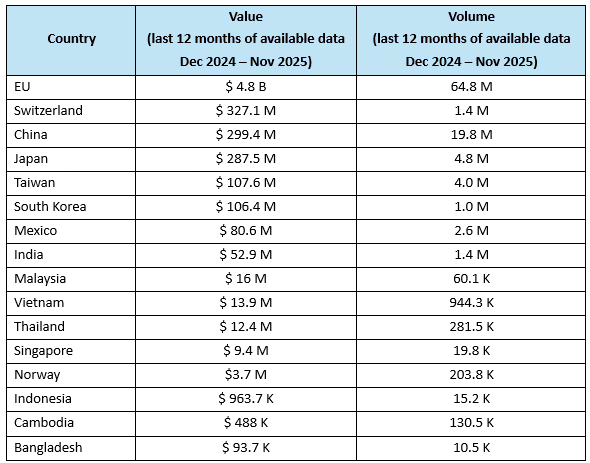
Below is the list of countries under investigation, value and volume of priority imports in aggregate, and rank in terms of source countries for the most recent year.