Maine:
• Future restrictions on HVAC and refrigeration equipment.
• Effective Jan. 1, 2040.
• Read more here.
Minnesota:
• Bord product restrictions and reporting
• Reporting deadline 15 September 2026
• “Amara’s Law” – prevents intentionally added PFAS in specified consumer product categories.
• Establishes boarded prohibition for products containing intentionally added PFAS beginning Jan. 1, 2032.
• Read more here.
New Mexico and Vermont:
• Broad Future Product Restrictions
• Restricts products containing intentionally added PFAS in 2032.
Generally, many of these areas are subject to statutory exemption and implementation requirements. Also, of these regulations and laws, many are focused only on intentionally added PFAS.
States with Targeted Product, Packaging or Gear Bans:
• California - food packaging and consumer goods
• Washington - Food packaging and targeted consumer product categories
• New York - firefighting PPE, apparel and cosmetics, industrial wastewater and discharge limits
• Rhode Island - manufacture, distribution and sale of turnout gear and products containing intentionally added PFAS
• Colorado - multiple consumer and industrial product lines
• Illinois, New Jersey, Vermont, Michigan, New Hampshire and Oregon – currently very water focused.
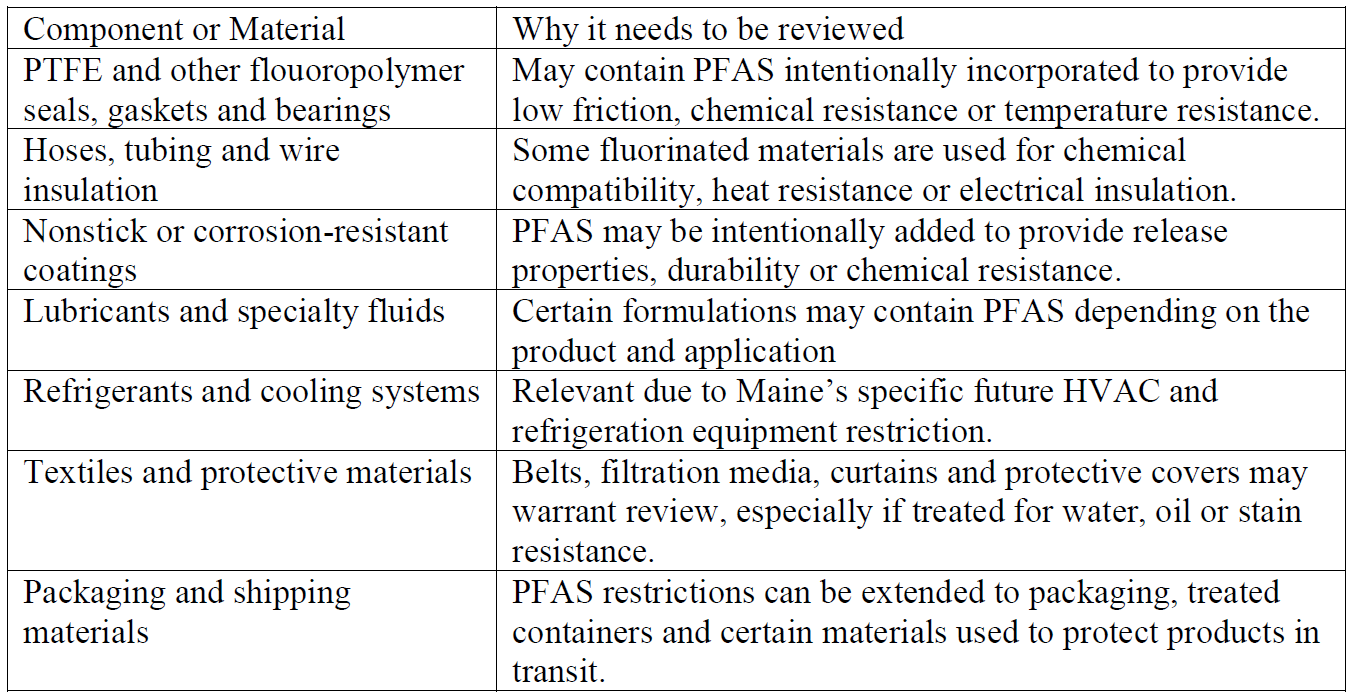
What parts of a machine could be affected?
What do manufacturers need to do now?
Priority 1 – Build a PFAS inventory
• Create a list of PFAS-containing or potentially containing materials in every machine and its replacement parts
• Focus on:
o Food-contact belts, seals, gaskets and tubing
o PTFE and other fluoropolymer components
o Nonstick or corrosion-resistant coatings
o Lubricants, hydraulic fluids and process fluids
o Filters, membranes, insulation and packaging.
• Record the supplier, part number, materials, chemical identity where available and reason for PFAS.
Priority 2 – If you ship to MN check reporting requirements immediately
• If you determine your company is the responsible manufacturer for any products sold, offered for sale or distributed in MN you need to report this.
• The deadline for this has passed. Companies need to contact Minnesota Pollution Control Agency to establish next steps.
• Going forward, these reports need to be updated every February 1 when required.
Priority 3 – Send supplier information requests
• Ask component suppliers to identify intentionally added PFAS and request detailed chemical or material data, any applicable exemptions and any additional relevant information